If you're taking a language course
Enter the class code from your instructor when you sign up, so your practice counts for your course. Already signed up? Choose "Join a course" in the app menu before you practice.
Practice guide
Talio is an AI conversation partner for language practice. You open it and have a spoken conversation on your own schedule. Here's how to make a short session count.
Talio isn't trying to replace talking with real people. It's the practice in between: where you get the reps in and make the mistakes, so the human conversations can go further.
The goal isn't the conversation with Talio. It's the conversation you have afterward.
“I forgot I was talking to an AI.”
Enter the class code from your instructor when you sign up, so your practice counts for your course. Already signed up? Choose "Join a course" in the app menu before you practice.
Talio runs in your browser, so there's nothing to install. Use a headset if you can, and find a quiet spot: Talio is responding to your actual speech.
Drill one skill until it clicks, then mix in new conversations.
Step 1
Open Proficiency and pick an "I can..." statement you haven't shown yet.
Step 2
Choose Explore scenarios on that statement. Or describe a situation you'll actually face, like a job interview next week, and Talio builds one at your level.
Step 3
Talk like it's real. Press End Conversation when you're done so it gets analyzed.
Step 4
A few minutes later it's under My Transcripts with your feedback. Listen to a couple of your own turns.
Step 5
A couple more reps back to back, then the same scenario a day or two later.
Step 6
Proficiency shows the evidence so far. It takes repeated evidence across conversations, so one loop may not change it.
There's no risk and no downside, so experiment and push your limits. Say more than the minimum, try the harder tense, use the word you've heard but never said. A clumsy sentence that gets your meaning across has done its job.
Ask the tutor to repeat it or say it another way. If the word won't come, describe it or use a simpler one.
It's natural turn-taking, not push-to-talk. In a scenario, the tutor responds to what you mean and keeps the conversation going. Feedback on how you said it comes afterward.
Try it in your first conversation.
Start talkingThe conversation is the practice. The analysis shows you what to work on next. Two rules apply to every number: the goal is to be understood, not to sound native, and the fairest comparison is you against yourself on the same kind of scenario.
Not everyone wants a wall of charts. After a few conversations Talio picks the focus for you: your words to review today and a recommended scenario are on the home screen.
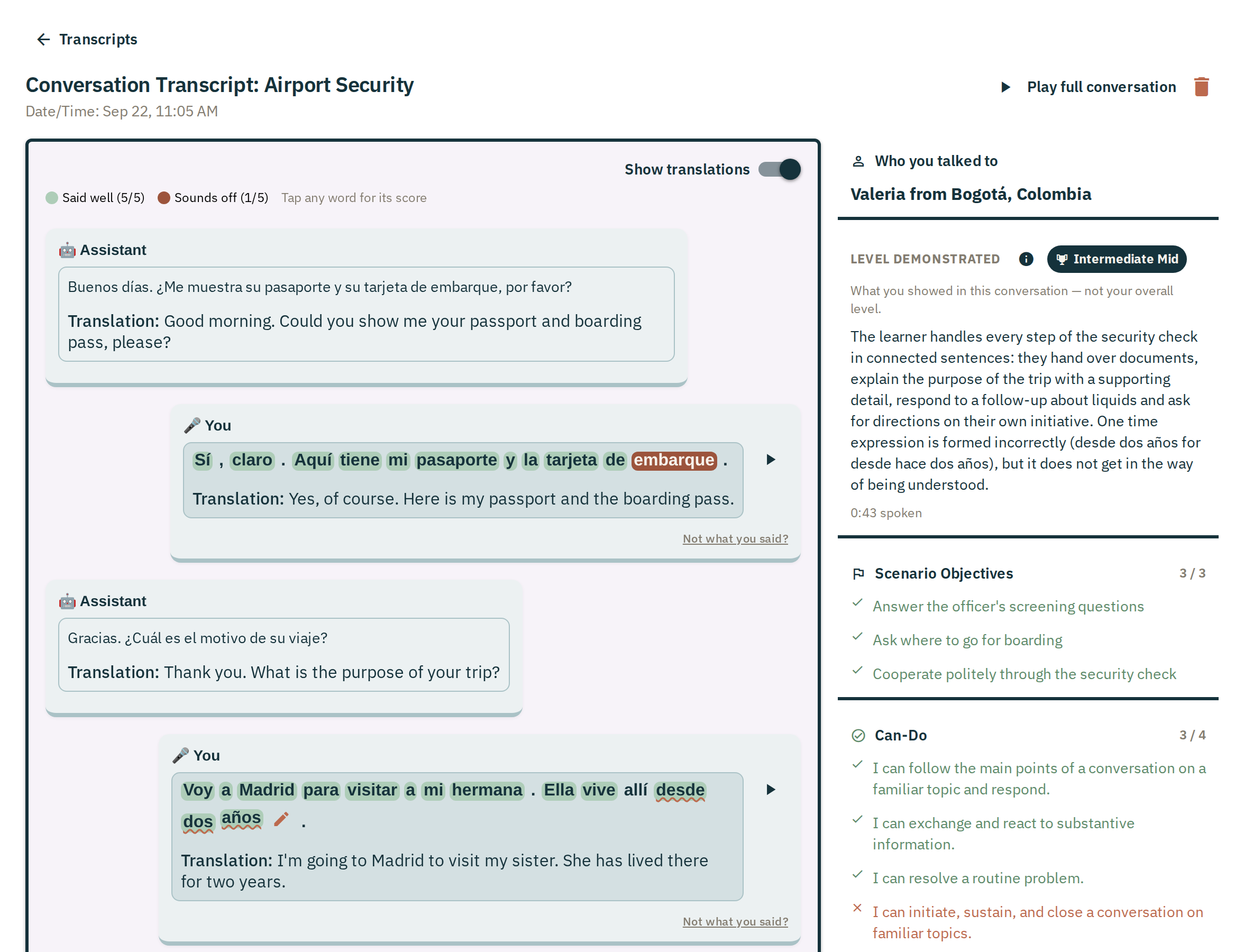
Everything you said, with each word marked for pronunciation, plus tips where a different phrasing would be more natural. Pick one tip per conversation and use it on purpose next time.
Whether the conversation gave evidence of specific speaking abilities. "Demonstrated" means you showed the ability more than once, not that you've mastered it.
How clearly a listener could make out what you said, and how closely your sounds match the expected ones. Neither is an accent score. When one dips, find the few words that came through poorly and say them again, carefully.
Speaking speed, how much you say between pauses, and how varied your words are. None is a score, and faster is not better. Repeat a scenario and watch whether your runs get longer.
Three or four short sessions across the week are a better plan than one long one. Read your trends by the month, not the day: any one conversation can be up or down because of the scenario, the topic or your morning.
Pick a situation, say more than you think you can, and read what comes back.
Talio is still actively being built, so expect things to shift and improve. Questions or suggestions? Tell us.