For instructors
Speaking practice your students do between classes
Talio is a virtual TA for second-year courses and up. Each student has spoken conversations between class meetings, and you see how much each student practiced.
A week with Talio
Step 1
Students join your course
Once, at the start. Students join with the access code issued for your course, and agree to share their practice with you.
Step 2
Students talk
Each student picks a scenario and has the conversation out loud, when it suits them, and gets feedback a few minutes later. Ask them to repeat a scenario on two different days.
Step 3
Check who practiced
My Courses shows each student's speaking time, week by week. Then use it in class: ask what was hard to say, and teach that.
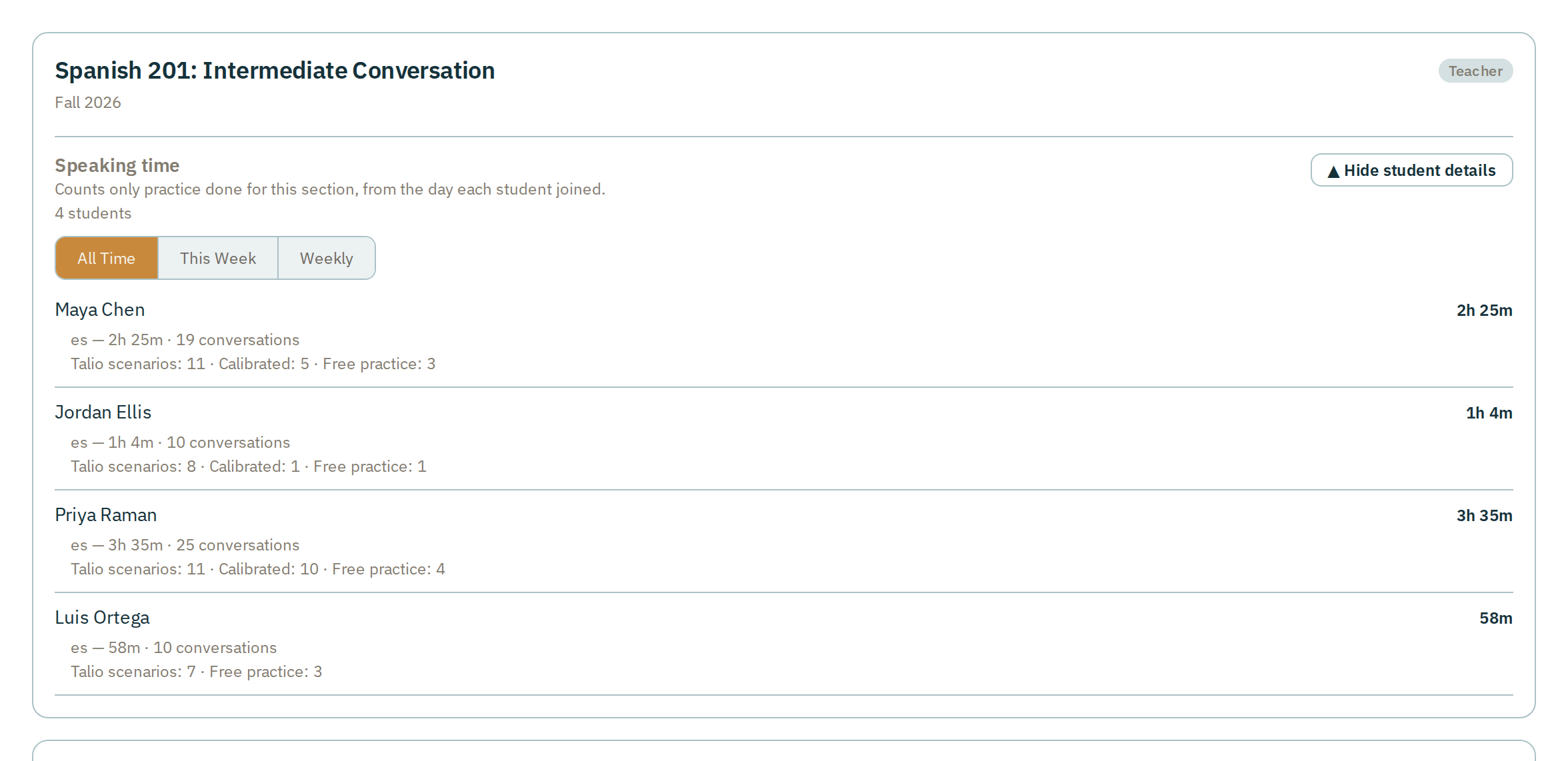
The view shows time spent speaking for your course, not scores. So grade the practice, not the numbers: the measures students see move with the scenario and don't compare fairly between students. More on the instructor view →
For the course where students can talk, but don't get to
Your students can already build sentences. What they need now is a lot of speaking, with someone who answers back.
Conversational proficiency takes volume, breadth and feedback, and a class period can't supply enough of any of the three. Teacher time is the constraint, not teacher skill. Talio is not a first-week tool, though: a true beginner needs you before open conversation is useful.
Where instructor time is shortest, such as less commonly taught languages and self-directed study, a speaking partner is the hardest thing to schedule. Talio is being used for research in an R1 university's Facilitated Interdependent Language Learning (FILL) program.
How Talio lifts the load
You can't be every student's speaking partner. Talio can, and it's built to get students talking: the tutor keeps its turns short and hands the conversation back. See how Talio compares with a generic AI tutor →
Practice happens without you
Students get their reps between classes, on their own schedule, and arrive having already practiced out loud. Class time goes to what needs a person.
Feedback you don't have to write
In a scenario conversation the tutor responds to what students mean and keeps them talking. Feedback on how they said it comes afterward, tied to things they actually said.
Repetition without boring the room
The second time through a scenario, students tend to pause less and say more. Repeating is easy on their own and hard to do in class.
Scenarios students can picture themselves in
Learners who can picture themselves using the language report putting in more effort and sticking with it longer. They can build a scenario around a situation they actually expect to be in.
The goal: AI that leads to more human conversation
Talio isn't a replacement for teachers, classmates or native speakers. It's the practice in between, so the human conversations can go further. You still decide what is worth practicing and hear things no software hears. Research on AI conversation partners is still young, and none of it is about Talio. Run a study with us →
Try it with one unit
Fifteen minutes on a call is enough to plan the first week.
Deciding for a whole program? See Talio for language programs →